Newsletter Archive
Summer 2017 A Message from Paul
One of the things I enjoy most about my job is the people that I am able to work with—people who are whole-heartedly dedicated to making a positive difference in the world.
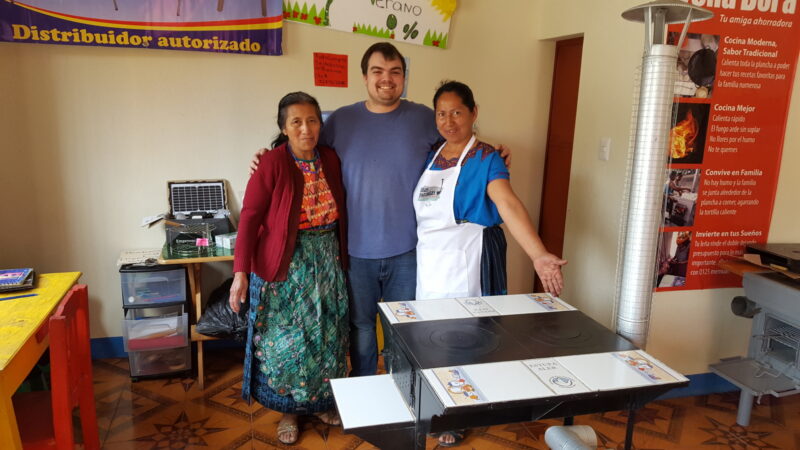
In this issue of our newsletter, you will meet three of them: Ryan, a graduate mechanical engineer from Cal Poly Pomona, who worked with us all summer until September 22; Hardik, a graduate student from the University of Dayton, who will be working with us all fall; and Duncan, now a senior from Vashon High School.
He is not mentioned elsewhere in this newsletter, but I also want to tell you about Phillipe Williamson, a recent graduate from Cornell University who just finished his master’s in mechanical engineering. Phillipe heard about Burn Design Lab from Art Sullivan, who worked with us for almost two years. (See the July 2016 and March 2017 newsletters.)
Unfortunately, we didn’t have funding to offer Philippe a position. Nevertheless, Philippe wanted to work with us so much that he came to Seattle (where he stayed with a friend of his) and volunteered three days a week all summer long, simply in exchange for his ferry fare, hoping that a position would eventually open up.
September 13 was Philippe’s last day. In his time here, he made important progress in researching materials for longer-lasting cookstoves. When he left, he said it had been an absolute pleasure working with the team. This is what makes our progress possible: hard-working, bright, energetic young people with a passion for making a difference in the world. ~ Paul Means, Executive Director, Burn Design Lab
Brian's Trip to Ghana
During my first year at Burn Design Lab, I have had the chance to solve many problems. So far, I have contributed to charcoal stove designs for Kenya and plancha stove designs for Guatemala, and conceived different stove ideas for the Philippines. My understanding of the problems in these countries grew out of reports conveyed to me in writing and by word of mouth, but which I never experienced first-hand. Then BDL executive director Paul Means asked me to go to Ghana with him to scope a completely new project: improving the shea roasting process. I had never heard of shea in my life, let alone the means by which it is processed, and that made the prospect of actually going to Ghana to learn about it even more exciting.
Shea is a fruit which grows on trees scattered across the landscape and whose nut is processed into shea butter—the primary ingredient in many soaps, creams, and other cosmetic applications, and a substitute for cocoa butter. Shea is processed across Africa in a region known as the “shea belt” which runs through northern Ghana.
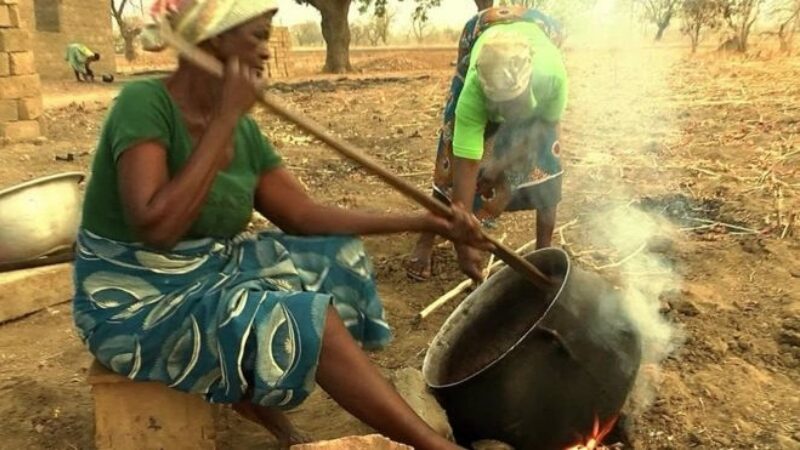
Women are the primary harvesters and processors of shea. The specific step of the process Paul and I were looking into was the roasting step. The crushed shea nuts are roasted in large cylindrical drums over an open fire. The first processor we visited was located in Tamale, where three women were roasting during our visit. The women were roasting within 10 feet of one another, so the smoke from one fire was blowing right into the other’s faces, and their children were lying on blankets enveloped by the smoke of the three roasters. If that sight alone did not make me aware of the issues, I became very aware when I began to measure the temperature of the equipment they were using. It was extremely uncomfortable to be within one foot of the roasters for more than a few seconds, as the heat and smoke quickly irritated my eyes and lungs. The women rotate these drums by hand for one to eight hours per day.
Over the next six days, we visited several other shea processing facilities, and the problems became more apparent at each stop. Women spoke of terrible lower back, elbow, wrist, and shoulder pain in addition to the issues of smoke inhalation and heat exposure. At the end of the 10-day trip, it was obvious to me that a solution to these problems is desperately needed — a conclusion that was all the more visceral because I had experienced the situation first-hand.
BDL is amazing because it allows for user-centered design to take place in a relatively large capacity with a small team. To be able to visit and meet with the people who will benefit from an improved shea roaster is that much more motivating because I really got to see how they live and hear directly from them what they need. I am very grateful to have had the opportunity to experience Ghanaian culture, and I am very excited to develop an improved technology that can have a significant impact on these people's lives. ~ Brian Gylland, Engineer, Burn Design Lab
Plancha Stove Project: A new Perspective
During my first year at Burn Design Lab, I have had the chance to solve many problems. So far, I have contributed to charcoal stove designs for Kenya and plancha stove designs for Guatemala, and conceived different stove ideas for the Philippines. My understanding of the problems in these countries grew out of reports conveyed to me in writing and by word of mouth, but which I never experienced first-hand. Then BDL executive director Paul Means asked me to go to Ghana with him to scope a completely new project: improving the shea roasting process. I had never heard of shea in my life, let alone the means by which it is processed, and that made the prospect of actually going to Ghana to learn about it even more exciting.
Shea is a fruit which grows on trees scattered across the landscape and whose nut is processed into shea butter—the primary ingredient in many soaps, creams, and other cosmetic applications, and a substitute for cocoa butter. Shea is processed across Africa in a region known as the “shea belt” which runs through northern Ghana.
Women are the primary harvesters and processors of shea. The specific step of the process Paul and I were looking into was the roasting step. The crushed shea nuts are roasted in large cylindrical drums over an open fire. The first processor we visited was located in Tamale, where three women were roasting during our visit. The women were roasting within 10 feet of one another, so the smoke from one fire was blowing right into the other’s faces, and their children were lying on blankets enveloped by the smoke of the three roasters. If that sight alone did not make me aware of the issues, I became very aware when I began to measure the temperature of the equipment they were using. It was extremely uncomfortable to be within one foot of the roasters for more than a few seconds, as the heat and smoke quickly irritated my eyes and lungs. The women rotate these drums by hand for one to eight hours per day.
Over the next six days, we visited several other shea processing facilities, and the problems became more apparent at each stop. Women spoke of terrible lower back, elbow, wrist, and shoulder pain in addition to the issues of smoke inhalation and heat exposure. At the end of the 10-day trip, it was obvious to me that a solution to these problems is desperately needed — a conclusion that was all the more visceral because I had experienced the situation first-hand.
BDL is amazing because it allows for user-centered design to take place in a relatively large capacity with a small team. To be able to visit and meet with the people who will benefit from an improved shea roaster is that much more motivating because I really got to see how they live and hear directly from them what they need. I am very grateful to have had the opportunity to experience Ghanaian culture, and I am very excited to develop an improved technology that can have a significant impact on these people's lives. ~ Brian Gylland, Engineer, Burn Design Lab